
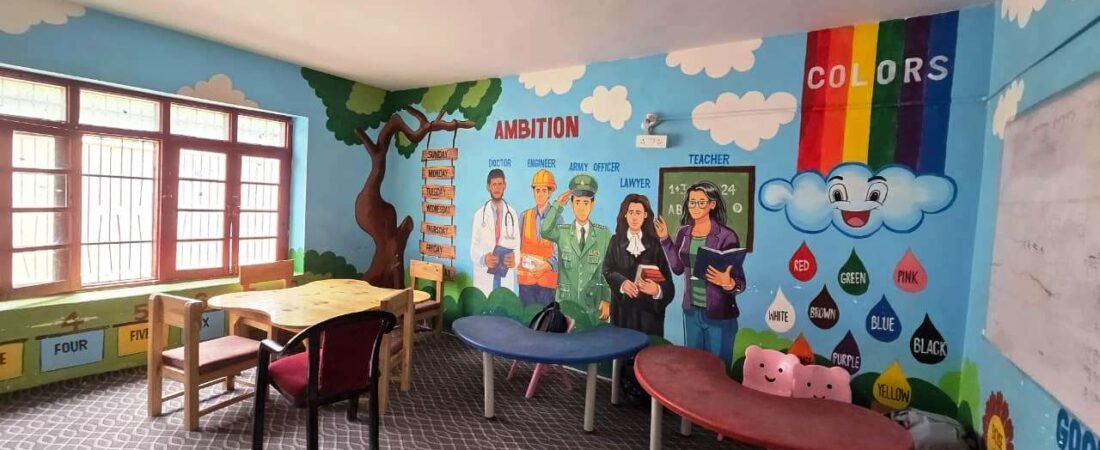
Shey, Leh-Ladakh: Govt High School, Shey is emerging as a promising example of how a government school can combine committed teaching, community participation, modern educational practices and institutional development to create a stronger learning environment for students in the region.
At a recent event, local education officials praised the dedication of the school’s faculty and acknowledged the important role played by the village community in supporting the institution. Their appreciation reflects a broader transformation taking place at the school, where academic development is increasingly being supported by innovative teaching practices, improved infrastructure and greater community engagement.
The school’s progress assumes added significance under the PM SHRI (Pradhan Mantri Schools for Rising India) initiative, through which Govt High School, Shey has been designated to serve as a mentor institution. This responsibility places the school in a position not only to strengthen its own educational practices but also to support neighbouring schools across Leh district.
From a Local School to a Regional Resource
The role of a mentor institution goes beyond conventional classroom teaching. A mentor school is expected to demonstrate effective educational practices and help other schools learn from its experiences.
For Govt High School, Shey, this means sharing the knowledge and systems developed within the institution with neighbouring schools. Over the coming academic cycles, the school is expected to provide guidance in areas such as teaching methodologies, the effective use of technology, classroom innovation, school management and infrastructure development.
This approach creates an opportunity for successful practices to move beyond the boundaries of a single campus. Instead of each school having to develop solutions independently, schools across the district can benefit from shared experiences and locally relevant models.
Strengthening Teaching and Learning
One of the important areas of focus is the improvement of teaching and learning practices. Modern education increasingly requires teachers to move beyond traditional lecture-based instruction and create classrooms where students actively participate in the learning process.
At Shey, upgraded teaching methodologies and technology-enabled learning are becoming important components of this process. Teachers can use digital resources, visual material, interactive activities and smart classroom tools to make lessons more engaging and accessible.
Such methods can be particularly valuable in geographically challenging regions such as Ladakh, where schools operate in a distinctive social, climatic and geographical environment. Educational innovation therefore needs to be practical, adaptable and responsive to local circumstances.
The experience gained by the teachers of Govt High School, Shey can potentially provide neighbouring schools with useful examples of how technology and innovative pedagogy can be integrated into everyday classroom teaching without losing sight of local needs.
Smart Classrooms and Digital Education
The growing use of smart classroom facilities represents another important dimension of the school’s development.
Technology can transform the classroom from a largely textbook-based environment into a more interactive learning space. Students can be introduced to diagrams, animations, videos, digital presentations and other resources that help explain concepts in ways that complement conventional teaching.
However, technology alone does not guarantee better education. Its real value depends on how effectively teachers incorporate it into lessons. The experience of Shey’s faculty can therefore be significant for other schools seeking to make productive use of digital infrastructure.
By sharing practical approaches rather than simply providing equipment, the mentor-school model can help teachers understand how smart classroom resources can be connected to curriculum objectives and student learning outcomes.
Infrastructure as a Learning Model
Infrastructure is another area in which Govt High School, Shey can provide a useful example to other institutions.
A modern school environment requires more than classrooms. Learning spaces, digital facilities, sanitation, accessibility, safety, recreational areas and other supporting infrastructure all contribute to the overall educational experience.
The school’s upgraded infrastructure can serve as a reference point for neighbouring institutions seeking to improve their own facilities. The objective is not necessarily to replicate the school building exactly, but to identify practical ideas that can be adapted according to the requirements and resources of individual schools.
In this sense, the mentor institution becomes a centre for demonstration and learning—showing what can be achieved and helping other schools understand how similar improvements might be introduced in their own settings.
Teachers at the Centre of Change
Behind every successful school initiative are its teachers.
The appreciation expressed by local education officials for the Shey faculty highlights the importance of teacher commitment in bringing educational reforms into practice. New infrastructure and digital facilities can provide opportunities, but it is teachers who ultimately determine how effectively those resources are used.
The faculty’s experience can therefore become one of the school’s most valuable contributions as a mentor institution. Teachers from neighbouring schools can benefit from peer learning, demonstrations, discussions and exchanges of classroom practices.
This kind of professional collaboration can create a culture in which teachers learn from one another rather than working in isolation.
The Role of the Village Community
The development of a school is also closely connected with the community it serves.
The support of the Shey village community has been recognised alongside the efforts of the teaching staff. Community participation can strengthen the relationship between parents, teachers, students and the school administration.
When local communities take an active interest in education, schools are better positioned to understand the needs of their students and build an environment of shared responsibility.
For a school in a culturally distinctive region such as Shey, this connection is especially important. Educational development becomes more meaningful when modern learning approaches are combined with respect for local values, traditions and community aspirations.
A Model with District-Wide Potential
The designation of Govt High School, Shey as a mentor institution provides the school with an opportunity to influence educational development beyond its own campus.
Its role can gradually develop into a platform for sharing successful practices among schools throughout Leh district. Teachers and school leaders from neighbouring institutions may be able to observe classroom practices, learn about digital tools, discuss challenges and explore practical approaches to infrastructure and school development.
The long-term value of this model will depend on sustained collaboration. Mentorship should ideally be an ongoing process rather than a one-time exchange. Regular interaction, monitoring, feedback and adaptation can help ensure that successful ideas are translated into meaningful improvements at participating schools.
Education Beyond the Classroom
The broader vision represented by the Shey model is that school development is not limited to examination results.
A successful school seeks to develop students who are confident, curious, responsible and capable of adapting to a changing world. Academic knowledge remains central, but it can be strengthened through creativity, technology, communication, teamwork and experiential learning.
The combination of modern educational tools with committed teachers and community support creates favourable conditions for such an environment.
As a mentor institution, Shey can potentially demonstrate how these elements can work together in a government-school setting.
Looking Ahead
The coming academic cycles will be important for Govt High School, Shey. Its responsibility as a mentor institution presents both an opportunity and a challenge.
The opportunity lies in sharing its achievements and experiences with other schools. The challenge will be to maintain its own standards while providing meaningful and practical support to institutions with different needs and circumstances.
If sustained effectively, the initiative could create a network of schools in which good practices are shared, teachers collaborate, technology is used purposefully and infrastructure development is guided by real educational requirements.
In that sense, Govt High School, Shey can become more than a successful individual institution. It can become a regional learning hub, demonstrating how government schools can evolve through innovation, teacher commitment, community participation and institutional collaboration.
A Vision for the Future
The story of Govt High School, Shey represents a wider vision for education in Ladakh: that quality schooling can be strengthened by combining local participation with modern educational approaches.
Its recognition as a PM SHRI mentor institution gives the school a larger responsibility and a wider platform. By sharing its teaching methodologies, smart classroom practices and infrastructure models with neighbouring schools, Shey has the potential to contribute to a broader culture of educational improvement across Leh district.
The journey ahead will require sustained effort from teachers, students, administrators, parents and the community. But with these stakeholders working together, the school can demonstrate that meaningful educational transformation is possible even in geographically challenging regions.
From strengthening its own classrooms to mentoring neighbouring schools, Govt High School, Shey is taking a step toward becoming a model for collaborative and future-ready school education in the region.