
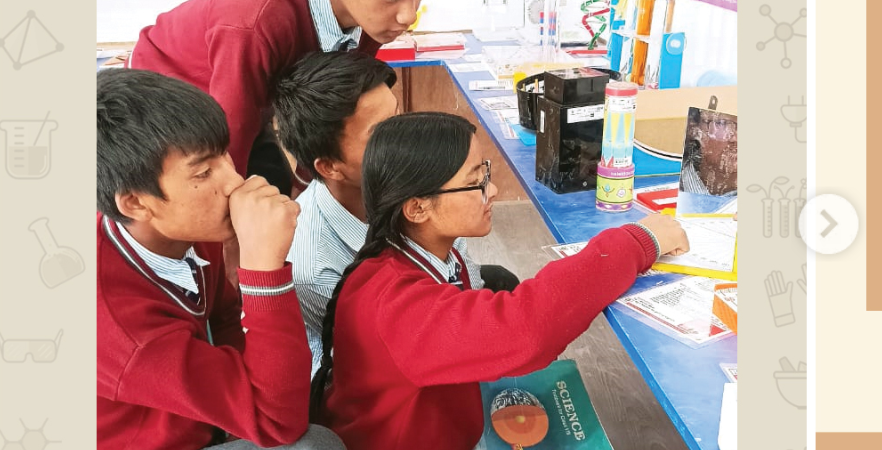
Among the most significant highlights of the event was the official exhibition of Govt High School, Shey’s Mini Science Centre and its advanced STEM-based learning frameworks. The exhibition provided a practical demonstration of the school’s efforts to move beyond conventional, textbook-oriented instruction and create learning experiences in which students can explore scientific concepts through observation, experimentation and discovery.
The Mini Science Centre represents an important step towards creating a culture of scientific curiosity within the school. Rather than limiting science education to theoretical explanations, the centre provides students with opportunities to interact with models, examine scientific principles and understand how concepts taught in classrooms operate in the real world.
Students at the Centre of Scientific Discovery
Students from Grades 8 to 10 played a central role in the exhibition. They actively demonstrated working scientific models and explained the principles behind them to visitors.
The student-led demonstrations included interactive models illustrating fundamental concepts of physics, including reflection of light and the working principles of corner mirrors. By operating the models and explaining their observations, students were able to demonstrate their understanding in a way that went beyond simply reproducing definitions from a textbook.
Such activities transform students from passive recipients of information into active participants in the learning process. They have to observe, question, experiment, explain and sometimes troubleshoot their models—skills that are fundamental to scientific thinking.
From Rote Learning to Discovery
One of the most important features of experiential STEM education is its ability to reduce dependence on rote memorisation.
Traditional learning can sometimes encourage students to remember formulas, definitions and principles without fully understanding how they work. Practical experimentation provides another pathway to knowledge. When students construct or operate a model, they encounter a scientific principle directly and can connect it with an observable outcome.
For example, a demonstration involving light reflection can allow students to see how the direction of light changes when it interacts with a reflective surface. A corner-mirror model can similarly provide an opportunity to explore how multiple reflections can produce useful visual effects.
The process of discovering these principles can make science more meaningful and memorable.
Making STEM Learning Interactive
The exhibition also demonstrated the value of interactive STEM education.
STEM—Science, Technology, Engineering and Mathematics—is most effective when students are encouraged to connect knowledge across disciplines. Building a working model may involve scientific understanding, mathematical reasoning, design skills, problem-solving and sometimes digital technology.
Such activities encourage students to think like young scientists and engineers. Instead of asking only, “What is the answer?”, students begin asking questions such as:
- Why does this happen?
- What will happen if I change the angle?
- How can I improve the model?
- Why did the experiment produce a different result?
- How can the same principle be used in everyday life?
These questions are at the heart of scientific inquiry.
Learning by Doing
The Mini Science Centre provides an environment in which learning by doing can become part of regular school life.
Practical activities allow students to learn through direct experience. They can make mistakes, modify their models and test their ideas again. This process teaches an important lesson: scientific learning is not simply about arriving at the correct answer; it is also about understanding why something works, investigating when it does not and developing better solutions.
For students in Grades 8 to 10, such experiences can be particularly valuable as they encounter increasingly complex concepts in science and mathematics.
Joyful and Learner-Centred Education
The approach demonstrated at Shey is closely aligned with the educational philosophy associated with the Pradhan Mantri Schools for Rising India (PM SHRI) initiative, which places emphasis on learner-centred, experiential and joyful learning.
The purpose of such an approach is to make students active contributors to their own education. When students are given responsibility for demonstrating a scientific model, explaining its working and answering questions, they develop confidence alongside subject knowledge.
The exhibition therefore served two purposes. It showcased the school’s scientific resources while also showcasing the students’ ability to understand and communicate scientific ideas.
Developing Scientific Temper
Experiential science education can also contribute to the development of a scientific temper.
Students who regularly engage with experiments learn to observe evidence, question assumptions and look for logical explanations. These habits are useful not only in science laboratories but in everyday life.
Encouraging young people to approach problems with curiosity and evidence-based reasoning can help develop independent thinkers who are better prepared to navigate a technology-driven society.
A Platform for Innovation
The Mini Science Centre can potentially become more than an exhibition space. With sustained use, it can serve as a platform for student innovation, project-based learning and interdisciplinary activities.
Students can be encouraged to design their own models, identify local problems and develop simple scientific or technological solutions. In a region such as Ladakh, this could open opportunities to explore themes relevant to the local environment and community, including renewable energy, water management, climate, sustainable development and appropriate technology.
Such projects can connect scientific education directly with the students’ surroundings, making learning both relevant and purposeful.
Sharing the STEM Experience
As Govt High School, Shey assumes its wider responsibility as a mentor institution under the PM SHRI framework, its experience in experiential STEM education could also benefit neighbouring schools.
The school can potentially share demonstration models, project ideas, teaching strategies and practical approaches to establishing science-learning spaces. Teachers from other institutions could learn how relatively simple models and experiments can be incorporated into classroom teaching to make difficult concepts easier to understand.
In this way, the Mini Science Centre can become part of the school’s broader contribution to educational development across Leh district.
Building Future Scientists and Problem-Solvers
The exhibition ultimately demonstrated an important principle: children learn science best when they are given opportunities to experience it.
The students’ active participation showed that scientific learning can be engaging, creative and collaborative. Their demonstrations of light reflection, corner mirrors and other working models provided visitors with a glimpse of how practical education can transform abstract concepts into visible and understandable experiences.
Govt High School, Shey’s Mini Science Centre therefore represents more than a collection of scientific models. It reflects a changing approach to education—one that values curiosity over memorisation, experimentation over passive learning and discovery over repetition.
As the school continues to develop its STEM initiatives, it has the potential to inspire students to become not merely successful examinees, but curious scientists, innovative engineers, thoughtful problem-solvers and confident learners prepared for the challenges of the 21st century.