SHEY (LEH): A Showcase of Educational Transformation Under NEP 2020
SHEY (LEH): In a significant stride towards fulfilling the core mandates of the National Education Policy (NEP) 2020, the PM SHRI Government High School, Shey successfully organized a major institutional showcase event, bringing together local administrative officials, members of the School Management Committee (SMC), village elders, parents, educators and heads of neighbouring institutions.
The event provided a comprehensive platform to showcase the school’s evolving educational ecosystem, including its upgraded infrastructure, technology-enabled learning facilities, green-campus practices, vocational initiatives, experiential STEM education and culturally rooted activities.
More than a conventional school function, the programme presented a picture of how a government school can gradually transform itself into a learner-centred, technology-enabled and community-connected institution, while remaining firmly rooted in the cultural and educational context of Ladakh.
A School Emerging as a Regional Model
The event highlighted the commitment of the school administration and teaching faculty towards translating the principles of NEP 2020 and the Pradhan Mantri Schools for Rising India (PM SHRI) initiative into practical classroom experiences.
Local education officials commended the dedication of the faculty and acknowledged the contribution of the Shey village community in supporting the school’s development.
The school’s growing institutional role has acquired additional significance with its designation as a mentor institution under the PM SHRI initiative. In this capacity, Govt High School, Shey is positioned to share its experiences, educational practices and developmental models with neighbouring schools across Leh district.
The mentorship approach creates the possibility of developing a network of schools where successful practices can be exchanged, adapted and strengthened according to local requirements.
Modern Infrastructure with an Educational Purpose
A key component of the showcase was the presentation of the school’s upgraded infrastructure and learning facilities.
The development of modern educational infrastructure is being approached not merely as a physical improvement but as a means of supporting better teaching and learning. Technology-enabled classrooms, improved learning spaces and other facilities can provide teachers with greater flexibility while giving students more opportunities to engage with lessons interactively.
The school’s infrastructure initiatives were presented alongside its green-campus practices, reflecting an understanding that a modern school must also promote environmental awareness and responsible resource use.
Such practices can turn the school campus itself into a learning environment, where students encounter principles of sustainability not only in textbooks but through everyday observation and participation.
Experiential STEM Learning Takes Centre Stage
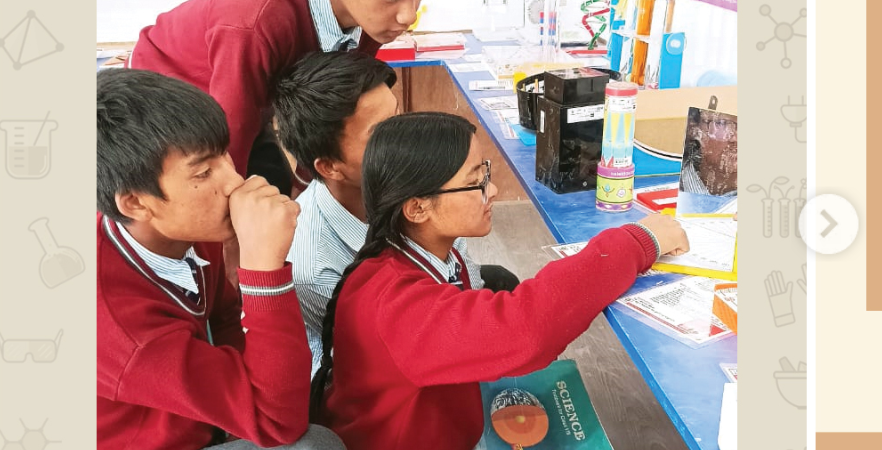
One of the major highlights of the programme was the exhibition of the school’s Mini Science Centre and STEM-based learning frameworks.
Students from Grades 8 to 10 actively demonstrated working scientific models, explaining concepts through practical experiments and interactive displays. Demonstrations included fundamental physics principles such as reflection of light and corner mirrors.
The student-led nature of the exhibition was particularly significant. Rather than simply displaying finished models, students demonstrated their working, explained the scientific principles involved and interacted with visitors.
This approach represents a shift from rote learning towards experiential and discovery-oriented education.
By constructing and demonstrating models, students learn to observe, experiment, troubleshoot and communicate scientific ideas. Such activities can make abstract concepts more accessible while simultaneously developing creativity, confidence and problem-solving skills.
The Mini Science Centre thus serves as an important platform for nurturing scientific curiosity and encouraging students to approach problems through observation and experimentation.
Moving Beyond Rote Learning
The educational approach demonstrated at the event reflects the broader learner-centred philosophy promoted under NEP 2020 and PM SHRI.
Instead of limiting students to memorising definitions and formulas, experiential education encourages them to understand how concepts work in practical situations.
A model demonstrating reflection, for example, enables students to observe the behaviour of light directly. Such experiences can create stronger conceptual understanding because students are able to connect theoretical knowledge with visible outcomes.
This transition from “learning by memorising” to “learning by doing” is central to developing independent and curious learners.
Vocational Training and the “World of Work”
Another important dimension showcased during the event was the school’s focus on vocational education and career-oriented learning.
School administrators presented the outcomes of recent skill-development programmes, including workshops conducted under the NCERT-led “World of Work” initiative.
Faculty members explained how vocational exposure is being integrated with the traditional curriculum to help students understand the relationship between education, skills and future employment.
The initiative seeks to expose students to the changing nature of work while developing qualities such as communication, collaboration, creativity, problem-solving and adaptability.
This is particularly relevant in an economy increasingly influenced by digital technologies and rapidly evolving occupational requirements.
Digital Literacy and Artificial Intelligence
Digital literacy has emerged as another important component of the school’s future-ready educational approach.
Students are being introduced to digital tools and concepts that can support learning, communication, creativity and problem-solving. The school is also providing exposure to basic concepts in Artificial Intelligence (AI).
At the school level, such exposure is less about advanced technical programming and more about developing technological awareness. Students can begin understanding what AI is, where it is used, how it affects society and why responsible use of emerging technologies matters.
The integration of digital literacy with conventional academic learning is intended to help students become more adaptable and prepared for the demands of higher education and the modern workplace.
Cultural Heritage at the Heart of Education
The event also celebrated the rich cultural identity of Ladakh through a series of student-led multi-genre cultural performances.
The school choir and local theatre groups presented performances reflecting Ladakhi heritage and traditions. The participation of students in these activities demonstrated how cultural education can be incorporated into the broader learning experience.
The emphasis on indigenous knowledge, local arts and traditions is consistent with the PM SHRI vision of creating schools that are rooted in their local context while preparing students for the future.
Cultural activities also provide opportunities for students to develop creativity, teamwork, communication and confidence.
By bringing traditional artistic expressions into the school environment, students are encouraged to appreciate their heritage and understand the importance of preserving it for future generations.
Student Leadership and Community Awareness
The programme further highlighted the active role of student leadership.
Students participated in an awareness drive demonstrating their engagement with wider public-awareness initiatives, including regional Viksit Bharat outreach activities.
Such participation provides students with practical opportunities to develop leadership, communication and organisational skills. It also encourages them to understand their role as responsible members of society.
The involvement of students in community-oriented initiatives reinforces the idea that education extends beyond examination results. A well-rounded education should prepare young people to participate constructively in their communities and contribute to social development.
Community Participation Strengthens the School
The presence of parents, village elders, SMC members and heads of neighbouring institutions added an important community dimension to the event.
The development of a school cannot be achieved by teachers and administrators alone. Parents and community members can play a crucial role in creating an environment in which educational initiatives receive local support.
For Shey, this relationship is particularly meaningful. The school is embedded within a community with a distinctive cultural heritage, and community participation can help ensure that educational modernization remains connected to local values and aspirations.
The event therefore represented not only institutional progress but also a shared community investment in the future of its children.
Green Campus and Environmental Responsibility
The school’s green-campus practices formed another important element of the institutional showcase.
Environmental sustainability is increasingly becoming an essential component of modern education. A green school can provide students with practical opportunities to understand conservation, responsible resource use and environmental stewardship.
When sustainability is incorporated into everyday school life, students can learn through direct experience. The campus itself becomes a practical laboratory where environmental responsibility is demonstrated rather than merely discussed.
For a fragile high-altitude region such as Ladakh, developing environmental awareness among young people carries particular significance.
Shey as a Mentor Institution
The school’s designation as a PM SHRI mentor institution gives these initiatives a wider significance.
The experience accumulated through infrastructure development, smart classrooms, STEM education, vocational programmes, digital literacy, cultural activities and green-campus practices can potentially be shared with neighbouring schools.
Mentorship can take the form of peer learning, demonstrations, teacher interaction, exchange of teaching resources and sharing of practical experiences.
The objective is not simply to replicate the Shey model in every school, but to enable neighbouring institutions to identify approaches that can be adapted to their own circumstances.
This could gradually create a stronger culture of collaboration among schools across Leh district.
Teachers as the Driving Force
Behind the infrastructure, technology and programmes showcased at the event are the teachers who convert these resources into meaningful learning experiences.
The commitment of the faculty was acknowledged by local officials, highlighting the central role educators play in implementing educational reforms.
Technology and infrastructure can create opportunities, but teachers determine how effectively those opportunities translate into student learning.
Continuous professional development, peer collaboration and experimentation with new teaching methodologies will therefore remain essential as the school expands its role as a mentor institution.
A Model for Future-Ready Government Education
The institutional showcase at PM SHRI Government High School, Shey offered a broad picture of educational transformation.
From smart classrooms and STEM models to vocational training, AI awareness, cultural activities and green-campus practices, the school is attempting to create an educational environment that responds to the diverse needs of 21st-century learners.
The event demonstrated that educational modernization is not simply about introducing new equipment. It involves changing how students learn, how teachers teach and how schools connect with their communities.
The integration of modern technology with local culture, practical skills with academic learning and student leadership with community participation presents a balanced model of school development.
Looking Ahead
The journey of Govt High School, Shey is still evolving. The coming academic cycles will provide an opportunity to consolidate the initiatives showcased during the event and strengthen their impact on students and neighbouring institutions.
Its role as a mentor school places an additional responsibility on the institution to document successful practices, support peer learning and contribute to the educational development of schools across Leh district.
If sustained through continuous teacher development, community participation, effective use of technology and meaningful student engagement, the Shey model could become an important example of how government schools in geographically challenging regions can embrace innovation without losing their cultural identity.
Conclusion
The institutional showcase at PM SHRI Government High School, Shey was ultimately a demonstration of an evolving vision of education—one that seeks to combine academic excellence, practical skills, scientific curiosity, digital literacy, cultural identity, environmental responsibility and community participation.
The school’s Mini Science Centre, vocational programmes, smart learning facilities, cultural initiatives and green-campus practices collectively reflect an educational philosophy centred on the learner.
As Govt High School, Shey moves forward in its role as a mentor institution, its greatest contribution may extend beyond its own campus. By sharing its experiences and encouraging neighbouring schools to experiment with new approaches, the institution has the potential to become a regional hub for innovative, inclusive and future-ready school education in Leh-Ladakh.
The event thus marked not merely a celebration of what the school has achieved, but a statement of what it aspires to become: a modern government school rooted in its community, inspired by its heritage and prepared for the future.